There are many ways to go about hiring a freelance editor to help you with your fledgling manuscript or document. You can trawl through the Yellow Pages, check Google, contact your local Writers’ Centres or dip into the directories of numerous Societies of Editors.
Just as there are hundreds of tradespeople to choose from, so there are hundreds of editors. So you narrow it down. You look for editors who specialise in your subject area. Maybe you take advice from fellow writers, get recommendations.
Finally, you have a list of people who you think would suit your manuscript. So what next?
When you contact a freelance editor and ask about hiring them to go over your work, often they’ll ask to see a sample of your manuscript before they’ll give you a quote for the cost and time it will take to complete the job.
Sounds pretty straightforward, yes? Yet for some reason this process can cause confusion and heartache, and possibly this is because writing is such a personal and creative endeavour. It’s (understandably) hard to suppress the need to impress and the fear of rejection.
The thing is, hiring an editor is really no different to hiring any tradesperson to work for you.* Most people understand that if they want to hire, for example, a plumber, to come and do a specific job, they will need to give them details of the work required in order to get an accurate quote.**
Imagine that you have a house with two bathrooms. One has recently been completely refurbished and just has a leaky tap that still needs repair. The other is completely run-down – all the tiles need replacing, there’s damp and mould. All the fixtures and fittings need repl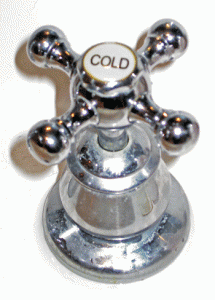 acing. In short, it’s a mess. You track down a tradesman with the right skills to do the job and tell him you have work for him. He agrees to come over to quote. You’re a bit embarrassed by the state of the old bathroom, so you just show him the leaky tap in the impressive new bathroom. He duly quotes for the work. You agree to the terms and he comes back the following week – at which point you show him into the old bathroom…
There is confusion. This is not the work he quoted for. This isn’t even the same job. This work will take much longer. It will cost more. It requires different tools. Both parties become equally frustrated.
This sounds like a ludicrous scenario.
But if you want to hire an editor to work on your manuscript, the principle is the same.
When an editor asks for a sample of your manuscript, they are asking because they need to know exactly what will be involved in working on this text.
By looking at sample pages, the editor can advise you as to what is necessary to bring the manuscript up to the standard you require.*** They can see for themselves whether the job will require a few hours simply correcting minor typing errors, or several weeks reworking awkward sentence construction and providing detailed feedback on better story structure. Often, what a writer describes as “a light proofread” can turn out to be “a heavy copy edit” if the author is hoping this will ultimately be a publishable or submittable work. It’s much better to know this up-front, when asking for the quote, rather than finding out once work has started.
When you’re considering which pages to send to the editor, then, it’s important to keep in mind why they are asking for the sample in the first place:
It’s not because they are short of reading material – they don’t need the whole manuscript at this point, and it’s unlikely that they need all the back story. The editor won’t be reading for enjoyment or to get a feel for the story at this stage, they just need to see what work and time is involved in the edit.
It’s not because they want to see how well you can write. At least, not the way you might be thinking. You are potentially hiring this editor to work for you, not the other way around. Although they will be giving you feedback at the end of the edit, it should be honest feedback that you have asked for. Remember, this is not someone who is going to offer you a publishing contract. This is not part of a submission process. This is not about impressing anyone.
Sending through the five  shiniest pages you have worked on solidly with a writing group may well prove to the editor that you have talent, but it won’t help with the quote if the other 450 manuscript pages turn out to be littered with disjointed dialogue, poor spelling and faulty grammar. It is in both your interests and the editor’s to send an “honest” sample so that you can get a proper quote.
As a writer, you will be understandably protective of your work. Editors know that you want to make sure that the person who will be working on your words really “gets” it. We know how important it is to you that we grasp every nuance. But these are concerns for the editing stage, not the quoting stage, even if it is tempting to add a few more chapters to the sample, and to send only the cleanest and best pages through. The finer details of the story don’t come into the calculations as to how many hours it’s going to take to correct all the punctuation and grammar, or whether it is likely to need a structural edit rather than a proofread.
Once you have the quote in hand, you can decide whether or not it suits your purpose. If this is your first time hiring an editor, make sure you’re really ready and keep in mind what that quote was for. That might sound stupid, but the perfectionist tendencies that see writers send in their most polished pages for a quote are the same ones that result in major rewrites post-quote. In theory there is nothing wrong with this, of course, except that an editor who has quoted for a 50,000 word manuscript will be just as surprised on receipt of a 150,000 novel as a tradesman would be on discovering that a bathroom refit suddenly also includes a kitchen refurbishment.****
What do you think? Does the quoting process send you quivering into a quandary over the perfect sample pages? Are you an editor? What are your tips? Do you drink tea, and if so, what’s your favourite?
*Editors probably work a little more quietly but they likely consume just as much tea. If not more.
**I know. You’re all just aching to tell me your home renovation/tradie horror stories. That is an entirely different blog topic. I shall not be moved. This is my metaphor, which is full of sunshine and happiness, tradesperson-wise.
***This is actually another important point – what sort of standard does the document need to be? Do you just want to get it to the next draft? Is it to be used in-house? Does it need to be publishable? Submission-level? Do you want to learn from the edit? This affects how the editor approaches the job as much as the style of edit.
**** In editing, this is an extremely common phenomenon. I didn’t even have to exaggerate the word count. I’m not sure how common the home renovation scenario is, to be fair, but I am not sure I have ever received a manuscript that hasn’t been worked on “just a bit” between quoting and start of editing.

Leave a Reply